Introduction
For sectors needing strength, corrosion resistance, and formability, 316L stainless steel strip has emerged as one of the most reliable materials among all stainless steel grades. 316L is a popular material for harsh settings, whether in chemical processing, maritime engineering, pharmaceuticals, or food equipment.
This blog will discuss the special benefits of 316L, its chemical makeup, how it differs from other UNS designations like UNS S31603 and UNS S31803, and why it’s important to know the difference between grades like 304 and 316.
What Is 316L Stainless Steel Strip?
A low-carbon variant of the 316 stainless steel grade is used to make 316L stainless steel strips, which are flat-rolled products. The “L” denotes a lower carbon content, which improves corrosion resistance and considerably lowers the chance of carbide precipitation during welding.
Key uses include:
- Heat exchangers and condensers.
- Flexible tubing and medical instruments.
- Springs, clamps, and precision components.
| Element | Percentage (% | Role |
|---|---|---|
|
Chromium (Cr |
16 – 18
|
Forms protective oxide film
|
|
Nickel (Ni)
|
10 – 14
|
Improves corrosion resistance, toughness |
|
Molybdenum (Mo) |
2 – 3
|
Increases resistance to chlorides & pitting |
|
Carbon (C) |
≤ 0.03
|
Prevents carbide precipitation during welding |
|
Iron (Fe) |
Balance
|
Structural backbone
|
UNS S31603: The Designation for 316L
For 316L stainless steel, the unified numbering system designation is UNS S31603. It covers ASTM and EN standards for plates, sheets, and strips. To guarantee uniformity across suppliers, engineers and purchasers search procurement documents for this code.
Advantages of UNS S31603 materials:
- Low carbon content for enhanced weldability.
- Superior resistance to localized corrosion in marine and chemical conditions.
- Consistent mechanical performance.
Comparing UNS S31603 and UNS S31803
UNS S31803 designates Duplex 2205 stainless steel, whereas UNS S31603 corresponds to 316L. For sectors weighing cost vs performance, the comparison is frequently pertinent.
- Austenitic, extremely formable, excellent weldability, and superior in low-to-medium chloride conditions is UNS S31603 (316L).
- The duplex structure (austenitic + ferritic) of UNS S31803 (Duplex 2205) offers greater strength, improved resistance to stress-corrosion cracking, and is better suited for hostile chloride environments.
When to choose which?
- Go with a stainless steel strip 316L if you need formability, easy fabrication, and moderate chloride resistance.
- Choose S31803 Duplex for higher mechanical strength and resistance in offshore, desalination, or oil & gas projects.
How to Check Stainless Steel 304 and 316?
A common question buyers face is: how to check stainless steel 304 and 316?
Here are simple ways to differentiate:
- Chemical test kits: Detect molybdenum (present in 316, absent in 304).
- Spark test: Not reliable for exact grade but useful in sorting.
- XRF Analyzer: Provides precise composition.
- Visual cues: 316 performs better in chloride-rich environments; 304 may show pitting.
The difference is critical: 316L (with molybdenum) offers far greater resistance to saltwater and acidic media compared to 304.
Industrial Applications of 316L Stainless Steel Strip
The versatility of 316L makes it a trusted material in:
- Marine Engineering
- Resistant to chloride-induced corrosion.
- Used in ship fittings, boat shafts, and seawater pipelines.
- Resistant to chloride-induced corrosion.
- Pharmaceutical & Medical
- Biocompatible and sterilization-friendly.
- Found in surgical instruments, implants, and cleanroom equipment.
- Biocompatible and sterilization-friendly.
- Food & Beverage Industry
- Non-reactive surfaces prevent contamination.
- Used in processing machinery, tanks, and kitchen equipment.
- Non-reactive surfaces prevent contamination.
- Chemical & Petrochemical Plants
- Handles acids and solvents safely.
- Used in heat exchangers, piping systems, and storage tanks.
- Handles acids and solvents safely.
- Energy & Power Plants
- Performs under high pressure and temperature.
- Essential in condensers and boiler tubing.
- Performs under high pressure and temperature.
Advantages of Using Stainless Steel Strip 316L
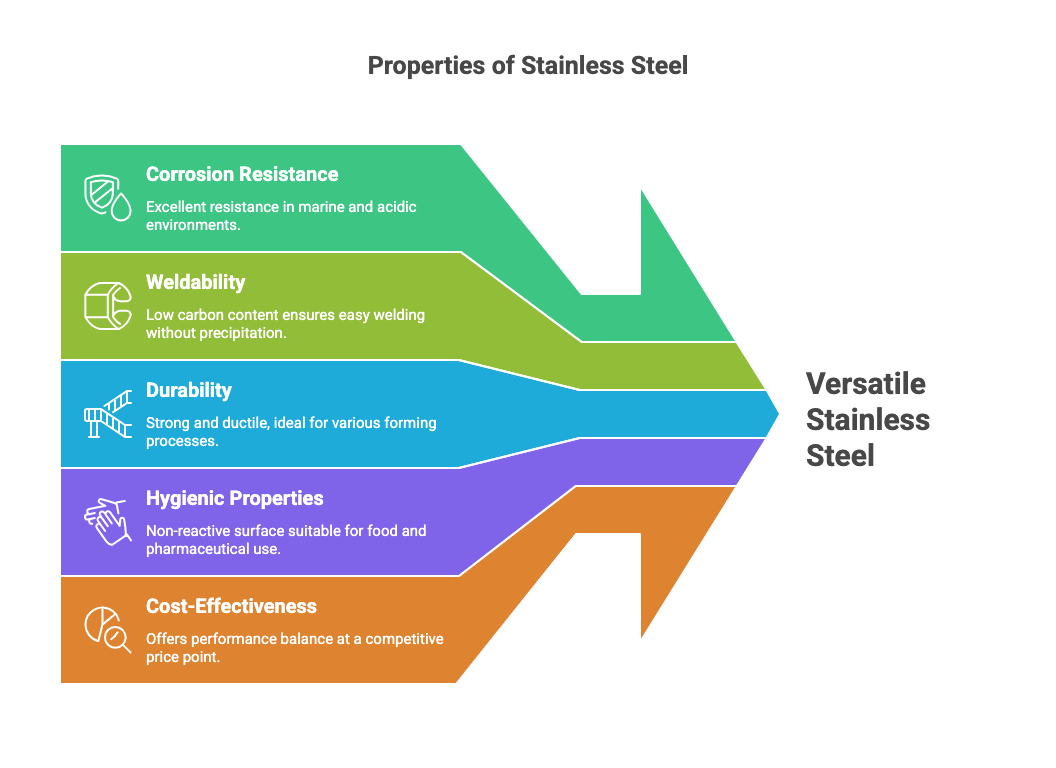
- Corrosion Resistance: Excellent in marine and acidic environments.
- Weldability: Low carbon content prevents carbide precipitation.
- Durability: Strong, yet ductile enough for forming.
- Hygienic Properties: Non-reactive surface for pharmaceuticals and food.
- Cost-Effectiveness: Balance of performance and price compared to higher-grade alloys.
Conclusion
Because it offers corrosion resistance, strength, and versatility at a competitive price, stainless steel strip 316L is used by industries. This alloy, which is classified under UNS S31603, is still the preferred option for the industrial, chemical, medical, and marine industries.
Engineers and purchasers are better equipped to make decisions when they are aware of the chemical makeup of stainless steel 316L, know when to use substitutes like UNS S31803, and know how to distinguish between stainless steel 304 and 316.
In a world where dependability in harsh settings is essential, 316L stainless steel strips offer long-term value and reliable performance.
FAQs
It is a low-carbon version of 316 stainless steel, flat-rolled into strips, offering superior corrosion resistance and weldability.
It is the unified numbering designation for 316L stainless steel across international standards.
UNS S31803 (Duplex 2205) offers higher strength and chloride resistance, while UNS S31603 (316L) provides better formability and weldability.
Use a chemical test for molybdenum or an XRF analyzer—316 contains molybdenum, while 304 does not.
Because of its low carbon content, 316L is more resistant to carbide precipitation during welding, making it more reliable in long-term service.
 2025 Stellanox Steel |